
Crawl Space Mold & Encapsulation in Charleston
Musty smell in the house, damp insulation hanging under the floor or white fuzz on the joists? We connect Charleston-area homeowners with local mold inspection and remediation companies for free, no-obligation quotes on crawl space cleanup and encapsulation.
Get a Free Quote Call (727) 300-6656Why Lowcountry crawl spaces grow mold
A vented crawl space breathes outdoor air, and in Charleston that air is warm and wet for months at a time. The SC State Climatology Office puts August mean relative humidity at 79%, with July at 77%. NOAA’s 1991–2020 normals show about 52.5 inches of rain a year at Charleston International Airport, and June through September alone account for roughly 25.8 inches. When that humid air meets cooler floor framing and ductwork under an air-conditioned house, moisture condenses, and wood, insulation and dust become food for mold.
Raised homes are part of the Lowcountry landscape, and the City of Charleston is pushing new construction further in that direction. In April 2023 the city passed a stormwater ordinance amendment banning slab-on-grade foundations for new one- and two-family homes, duplexes and townhouses in the Special Flood Hazard Area, for permits applied for on or after January 1, 2024. The city’s reasoning: slabs are hard to elevate, and water can enter through cracked or settled slabs. Existing homes are not affected, but it means more new homes in flood zones will sit over crawl spaces or on raised foundations that need moisture control from day one.
Common signs of crawl space mold:
- A musty or earthy smell inside the house, especially when the AC runs
- White, gray or dark growth on floor joists, subfloor or sill plates
- Sagging or wet fiberglass insulation between joists
- Standing water, wet soil or condensation on ducts after heavy rain
- Cupping hardwood floors or soft spots underfoot
More on what is normal and what is not in our article on crawl space mold in the Lowcountry.
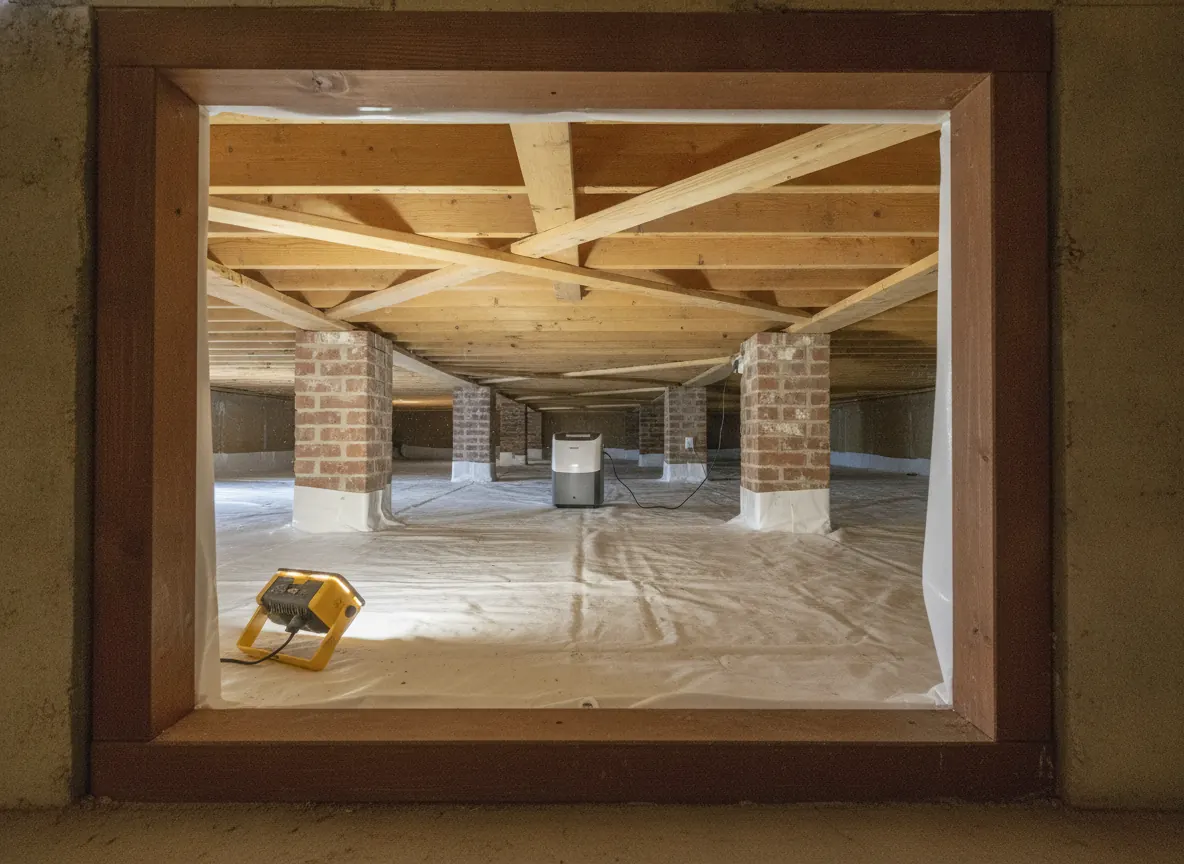
What a crawl space company typically does
Crawl space work usually has two parts. Remediation deals with the mold already there: a company will typically remove wet or moldy insulation and debris, clean and HEPA-vacuum the framing, and treat or sand affected wood. Moisture control keeps it from returning, and that is where encapsulation comes in.
Encapsulation generally means laying a heavy vapor barrier over the soil and up the foundation walls, sealing vents and gaps, and conditioning the space, most often with a dedicated crawl space dehumidifier. Some homes also need drainage fixes, gutter or grading changes, or a sump if water collects after storms.
Not every home needs full encapsulation. A crawl space with a small mold patch and a fixed plumbing leak may only need cleanup and a better vapor barrier. Our comparison of crawl space remediation vs. encapsulation walks through the trade-offs.
How a crawl space mold job usually goes
See the general mold remediation process for containment and clearance details.
Request quotes
Tell us about the smell, moisture or growth on the free quote form. We usually reply the same day.
Crawl space assessment
Each company checks moisture levels in the wood, soil and air, the condition of insulation and vents, and where water is getting in.
Written options
Ask for remediation-only and remediation-plus-encapsulation scopes so you can compare costs directly.
Cleanup
Moldy insulation and debris come out, and framing is cleaned and HEPA-vacuumed.
Moisture control
Vapor barrier, sealing, drainage fixes and a dehumidifier as agreed in the scope.
Follow-up
Ask how humidity will be monitored and what maintenance the dehumidifier needs.
Crawl space remediation vs. encapsulation costs
Typical national ranges from cost guides, 2024–2026 — not quotes.
| Item | Typical range |
|---|---|
| Crawl space mold remediation | $500–$2,000 |
| Crawl space encapsulation | $1,500–$15,000 (avg about $5,500; $3–$10 per sq ft) |
| Crawl space dehumidifier, installed | $800–$2,000 |
Square footage, clearance height, how much insulation must come out and whether drainage work is needed all move the price. The real number comes from the company’s on-site assessment. See the full mold remediation cost guide for other locations in the home.
Dehumidifiers and ongoing moisture control
In a sealed crawl space, the dehumidifier does the long-term work, so ask about its capacity, where it drains, filter changes and whether it can report humidity readings. A unit that stops running in August can undo an encapsulation. If your crawl space took on water in a storm, read about flood and water damage mold too.
South Carolina has no mold-specific license. South Carolina’s environmental agency (SCDES) says there are no state or federal laws, regulations or standards for mold, and it cannot test or inspect for mold in homes. A bill (H.5109) to create a state mold board was introduced in 2026 but has not passed as of October 2026. So ask any company about its training and certifications, its insurance, and the SC contractor license or registration for any rebuild work, and get the scope in writing. See what South Carolina law says. This is general information, not legal advice.
Frequently asked questions
Can mold in a crawl space get into the house?
Air moves from the crawl space up into living areas through gaps around pipes, wiring and ductwork, so crawl space odors and moisture often show up indoors. That is why musty smells are a common first sign. Fixing the moisture under the house and cleaning existing growth addresses the source rather than masking the smell upstairs.
Can mold grow in an encapsulated crawl space?
Yes, if moisture gets in. A torn vapor barrier, a plumbing leak, storm water or a dehumidifier that fails or is undersized can let humidity climb and mold return. Encapsulation reduces the risk but needs upkeep. Ask how humidity will be monitored and what maintenance the system requires before you sign.
How much does crawl space mold remediation cost?
Cost guides put crawl space mold remediation at about $500–$2,000. Full encapsulation typically runs $1,500–$15,000, averaging around $5,500 or $3–$10 per square foot, and an installed dehumidifier about $800–$2,000. These are national estimates; your price depends on the size, access and moisture problems found during an on-site assessment.
Do I need encapsulation or just mold cleanup?
It depends on why the mold grew. If a single leak caused it and the space otherwise stays dry, cleanup plus a fix may be enough. If humid outdoor air and damp soil keep the space wet, moisture control such as a vapor barrier and dehumidifier is usually what stops the cycle. Ask companies to quote both options.
Does homeowners insurance cover crawl space mold?
Coverage varies by policy and by cause. Mold from a sudden, covered water event is treated differently from mold caused by long-term humidity or maintenance issues, which many policies exclude. Read your policy and call your insurer or agent before work begins, and keep photos and the written scope for any claim.
Seeing or smelling mold? Get a clear plan.
Free, no-pressure quotes across Charleston, Mount Pleasant, North Charleston, Summerville and the Lowcountry.