
Open the crawl space hatch on a lot of Lowcountry homes in late summer and you will find damp air, sweating ductwork and, often, some mold on the wood. Is that normal? It is common here, for reasons that have more to do with climate and how houses are built than with anything a homeowner did wrong. Common does not mean harmless, though. This post covers why crawl spaces around Charleston get moldy, what the usual signs and smells are, and when it makes sense to have someone look.
Is crawl space mold common in the Lowcountry?
Yes, crawl space mold is a common finding in humid coastal areas, and the Charleston area checks every box. Mold needs moisture, a food source (wood joists, subfloor, paper-faced insulation, dust) and moderate temperatures. A vented crawl space under a Lowcountry home has all three for much of the year.
No study gives the share of Charleston-area crawl spaces that have mold, so be cautious with anyone who quotes a precise percentage. What the data does show is the climate those crawl spaces sit in.
Why Charleston's climate is hard on crawl spaces
NOAA's 1991–2020 normals for Charleston International Airport put annual precipitation at 52.51 inches. About half of that, 25.79 inches, falls from June through September, when temperatures are highest. July averages a high of 91.3°F and a low of 73.7°F.
Humidity follows the same pattern. The South Carolina State Climatology Office lists Charleston's August mean relative humidity at 79%, higher than Columbia or Greer (76%). Warm, wet outdoor air is what a vented crawl space breathes in all summer.
When that warm, humid air meets cooler surfaces under the house, such as air-conditioned ductwork, the underside of a cooled floor or the soil, moisture can condense. Wood that stays damp long enough can grow mold. Add a wet summer, a plumbing leak or standing water after a storm, and the moisture load goes up further.
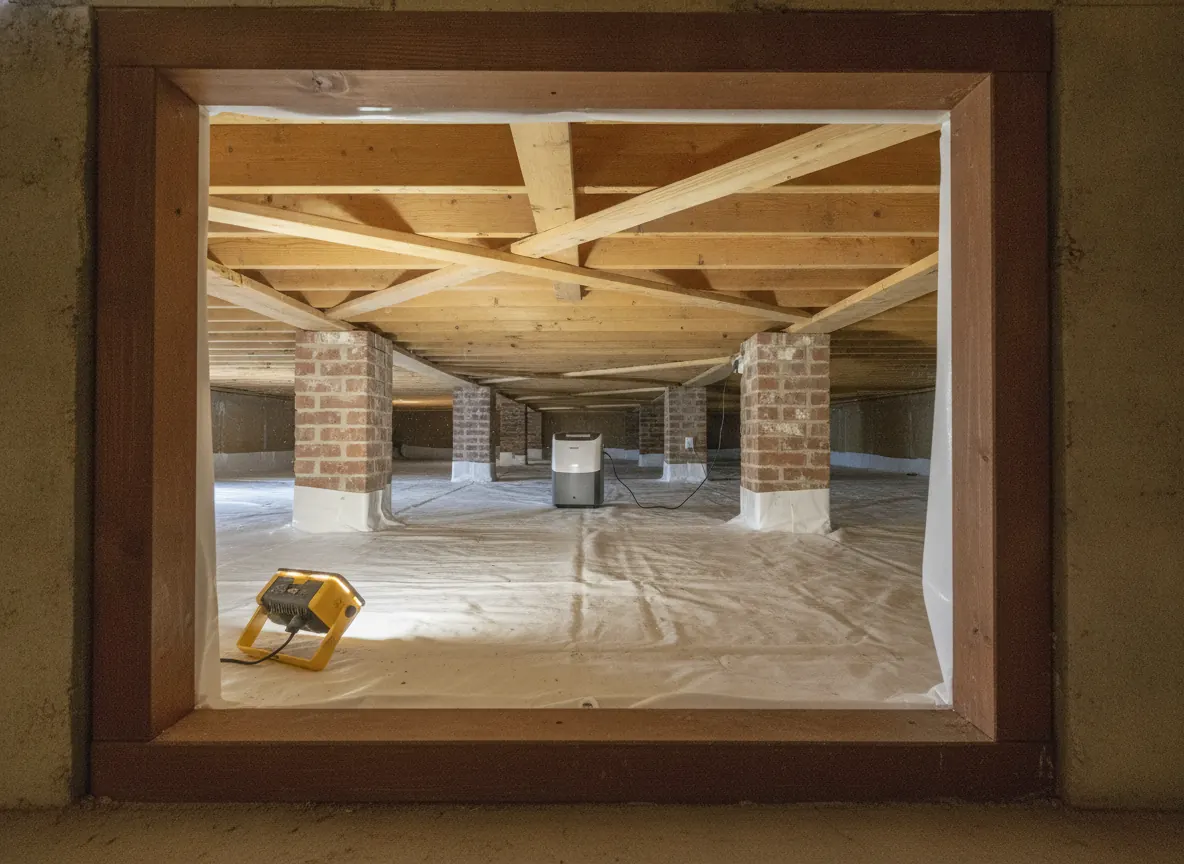
Raised homes and crawl spaces around Charleston
There is no dataset showing what share of Charleston-area homes sit on crawl spaces or raised foundations. A few facts help frame it:
- The City of Charleston now limits slabs in flood zones. An April 2023 stormwater ordinance amendment bans slab-on-grade foundations for new one- and two-family homes, duplexes and townhouses in the Special Flood Hazard Area, for permits applied for on or after January 1, 2024. The city's reasoning: slabs are hard to elevate, and water can enter through cracked or settled slabs. A 2022 draft described new homes being built above crawlspaces or on stilts. Existing homes are not affected.
- Regionally, slabs dominate new construction. Per NAHB's analysis of Census data, 85.7% of new single-family homes started in the South Atlantic division in 2024 were on slabs, and crawl spaces were 9.2% of starts nationally.
- Local contractors point to the water table. One contractor quoted by the Post and Courier said many Charleston homes sit on raised crawlspace foundations because the water table is a few feet below grade. That is a contractor's view, not a measured figure.
Housing age matters too. Census estimates put the median year built at 1970 for the Town of James Island and 1986 for Hanahan, compared with 2001–2002 for Summerville and Goose Creek. Older crawl spaces are more likely to have original vents, aging vapor barriers or none at all. See the James Island and Hanahan pages for more local detail.
Signs of crawl space mold
You do not need to crawl under the house to notice some warning signs. Common ones include:
- A musty, earthy smell in rooms above the crawl space, often stronger when the HVAC system first runs or after rain.
- Visible spots or fuzzy growth on joists, subfloor or sill plates, in white, gray, green or black.
- Insulation sagging or falling out of the floor cavities, often a sign it has absorbed moisture.
- Condensation dripping from ductwork or pipes, or standing water on the ground or vapor barrier.
- Floors that feel soft, cupped or bouncy, or wood floors that gap and swell with the seasons.
- Higher indoor humidity than you would expect with the AC running.
None of these confirms mold on its own. Wood can be stained without active growth, and some white deposits are mineral rather than mold. That is the job of an on-site assessment.
What does crawl space mold smell like?
People usually describe it as musty, damp, earthy or like wet cardboard or an old basement. Because air in a house tends to move upward, that smell can reach living spaces even when the source is under the floor. If the odor gets stronger after storms, in summer or when the system kicks on, moisture under the house is a likely suspect. A smell alone does not tell you how much mold there is, or where.
When to get a crawl space looked at
The EPA says that "if the moldy area is less than about 10 square feet," a homeowner can usually handle it. Crawl spaces make that hard to judge: they are tight, dark and often have more growth than you can see from the hatch. Consider having a company look when:
- You can see growth on more than a small patch of framing or subfloor.
- The musty smell has reached the living space and does not go away.
- There is standing water, a recent flood or a plumbing leak under the house.
- The vapor barrier is torn, missing or covered in water.
- You are buying or selling the home and want the condition documented.
If anyone in the home has health concerns related to mold, talk to a doctor.
A good assessment should identify the moisture source, not just the mold. The EPA puts it plainly: "If you clean up the mold, but don't fix the water problem, then, most likely, the mold problem will come back." In a crawl space, fixing the water problem may mean drainage, sealing vents, a vapor barrier, a dehumidifier, or full encapsulation. Our post on crawl space mold remediation vs. encapsulation breaks down what each option solves and typical costs.
After a storm or tidal flood, the timeline is shorter. See mold after a hurricane or king tide for the 24–48 hour drying window.
Getting quotes
Charleston Mold Experts is a free quote service. We connect Charleston-area homeowners with local mold inspection and remediation companies for free, no-obligation quotes. Read more about how crawl space work is usually approached on our crawl space mold & encapsulation page, then request free quotes. South Carolina has no mold-specific license, so ask each company about its training and certifications, insurance and, for any rebuild work, its SC contractor license or registration, and get the scope in writing.
Frequently asked questions
Do most crawl spaces in Charleston have mold?
There is no study measuring how many Charleston-area crawl spaces have mold, so treat any exact figure with caution. Mold is a common finding in humid coastal crawl spaces, and Charleston averages 52.51 inches of rain a year with August humidity around 79%. An on-site look is the only way to know about your home.
Can mold in a crawl space get into the house?
Air under a house can move up into living spaces through gaps in the floor, plumbing penetrations and ductwork, which is why crawl space mold often shows up first as a musty smell indoors. How much reaches the living space varies by home. If you have health concerns, talk to a doctor, and have the crawl space assessed.
Is a little mold on crawl space joists normal?
Light growth on joists is common in humid Lowcountry crawl spaces, but it signals that moisture is high enough for mold to grow. The EPA says small areas under about 10 square feet can usually be handled by a homeowner, but the moisture source still needs fixing or the mold will likely return.