
"Can I just clean this myself?" is a fair question when you spot mold on a bathroom ceiling, under a sink or on a window sill. In many cases the answer is yes. The U.S. Environmental Protection Agency gives homeowners a simple size guideline, a short list of safety basics and one rule that matters more than the rest: fix the moisture.
Charleston Mold Experts is a free quote service: we connect Charleston-area homeowners with local mold inspection and remediation companies for free, no-obligation quotes. This article sums up what EPA guidance says so you can decide whether a project is a weekend task or a job for a company.
The EPA 10-square-foot rule
EPA's homeowner guide, A Brief Guide to Mold, Moisture and Your Home, puts the line at about 10 square feet: "If the moldy area is less than about 10 square feet," a homeowner can usually handle the job. For reference, 10 square feet is about a 3-by-3-foot patch, or a strip 1 foot tall along 10 feet of baseboard.
It is a rule of thumb, not a law or a hard cutoff. South Carolina has no mold-specific rules for homeowners or companies; the state's environmental agency says there are no state or federal laws, regulations or standards for mold. A few square feet of surface mold on tile is a very different job from a few square feet that turn out to continue behind the drywall.
Step one: fix the moisture
EPA is blunt about this: "If you clean up the mold, but don't fix the water problem, then, most likely, the mold problem will come back." Before or alongside any cleanup, find out what is feeding the growth. Common sources in Lowcountry homes include:
- Plumbing leaks under sinks, behind toilets and around water heaters.
- Roof and window leaks after summer storms.
- Condensation on AC registers, ducts and cold surfaces. See our post on mold coming through AC vents.
- High indoor humidity. The SC State Climatology Office lists Charleston's average August relative humidity at 79%.
- Bathrooms without working exhaust fans.
After any leak or flood, EPA says "it is important to dry water-damaged areas and items within 24-48 hours to prevent mold growth." South Carolina's environmental agency uses the same 24-to-48-hour window.
EPA safety basics for small cleanups
We don't give medical advice, and this is a summary, not a substitute for reading EPA's guide. Its basic recommendations for homeowners cleaning up small areas include:
- Avoid breathing mold or spores. EPA suggests an N-95 respirator for small cleanups.
- Wear gloves. EPA recommends long gloves that reach to the middle of the forearm.
- Protect your eyes. EPA suggests goggles without ventilation holes.
- Clean hard surfaces by scrubbing with detergent and water, then dry them completely.
- Never mix bleach with ammonia. EPA warns never to mix chlorine bleach with cleaners or detergents that contain ammonia, because toxic fumes can result.
- Porous materials such as ceiling tiles and carpet may need to be thrown away if they become moldy.
- Don't paint or caulk over mold. Clean and dry the surface first.
- Health concerns first. If you have health concerns, EPA advises consulting a health professional before you start. Talk with your doctor.
When to call a remediation company
EPA's guidance points toward getting help in situations like these:
The area is larger than about 10 square feet
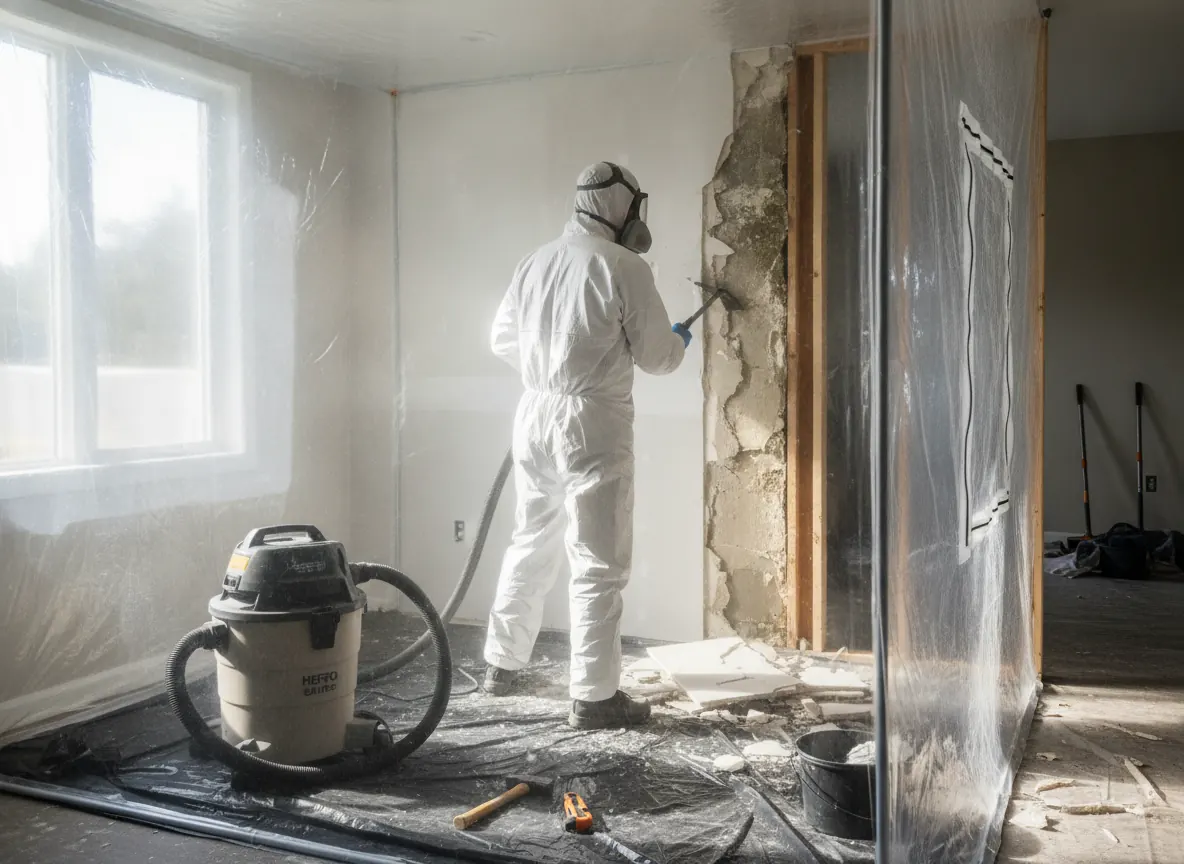
Bigger jobs usually need containment to keep dust and spores out of the rest of the house, plus removal of drywall, insulation or flooring. Remediation companies typically set up plastic containment and air filtration for this.
The water was sewage or floodwater
EPA recommends calling a professional when water or mold damage was caused by sewage or other contaminated water. That includes floodwater after hurricanes and king tides. Our post on mold after a hurricane or king tide covers the timeline.
The mold is in the HVAC system
EPA advises against running the system if you know or suspect it is contaminated with mold. HVAC work often needs both a remediation company and an HVAC contractor.
You can smell it but can't see it
Hidden growth behind walls, under floors or in a crawl space is hard to scope without opening things up. An inspection can help; see Do you need mold testing?
The crawl space or attic is involved
Crawl spaces and attics are cramped, hard to ventilate and often have more affected area than you can see from the hatch. Many homeowners search for how to remove mold from a crawl space themselves, but the moisture there usually needs a longer-term fix too. Read about crawl space mold and encapsulation and our post on attic mold removal.
What a company typically costs
If the job is past DIY size, it helps to know the ballpark. These are typical national ranges from cost guides, 2024–2026, not quotes:
| Item | Typical range |
|---|---|
| Mold remediation, typical job | $1,200–$3,750 (This Old House avg about $2,300); Fixr avg about $3,500 |
| Per square foot of affected area | $10–$30 |
| 50 sq ft / 100 sq ft | $500–$1,250 / $1,000–$2,500 |
| Crawl space mold remediation | $500–$2,000 |
The real price comes from an on-site assessment. See our mold removal page for how jobs are usually scoped, or the full mold remediation cost guide.
Choosing a company in South Carolina
South Carolina has no licensing program for mold inspection or removal, and a bill (H.5109) to create one was introduced in 2026 but has not passed as of October 2026. Related rebuild work is regulated: under SC Code §40-59-20, residential specialty contractors such as drywall and insulation installers register when the work exceeds $500. EPA's advice is simple: "make sure the contractor has experience cleaning up mold." Ask any company about its training and certifications, its insurance, and the SC contractor license or registration for any rebuild work, and get the scope in writing. More in our post on South Carolina mold license law. This is general information, not legal advice.
Frequently asked questions
Can you do mold remediation yourself?
Often, if the area is small. EPA's homeowner guide says that if the moldy area is less than about 10 square feet, a homeowner can usually handle it. That is roughly a 3-by-3-foot patch. Larger areas, hidden growth, mold in the HVAC system or water damage from sewage or floodwater are better handled by a company with experience cleaning up mold.
What is the EPA 10-square-foot rule?
It is a rule of thumb from EPA's A Brief Guide to Mold, Moisture and Your Home: if the moldy area is less than about 10 square feet, you can usually clean it up yourself. It is guidance, not a law or a hard limit. Above that size, EPA's mold cleanup guidance points homeowners toward hiring help.
What safety gear does the EPA recommend for mold cleanup?
For small cleanups, EPA recommends avoiding breathing mold or spores and suggests an N-95 respirator, long gloves and goggles without ventilation holes. It also warns never to mix bleach with cleaners containing ammonia. If you have health concerns, EPA advises talking with a health professional before you start. Read EPA's full guide before beginning any cleanup.
Will mold come back after I clean it?
It will if the moisture is still there. EPA's guidance says that if you clean up the mold but don't fix the water problem, the mold problem will most likely come back. Before or alongside cleanup, find and fix the leak, condensation or humidity source, and dry water-damaged materials within 24 to 48 hours.
Past the 10-square-foot line?
If your mold problem is bigger than a weekend cleanup, a free, no-obligation quote request takes about a minute, and we usually reply the same day. You decide whether to move forward.